
Introduction #
Some astronomical events are simply observed. Others pass through a generation and become part of public memory. The total solar eclipse of 12 August 2026 clearly belongs to the second group. For a few minutes, celestial mechanics became a shared public experience: schools, families, amateur astronomers, photographers, scientific teams and curious observers stopped to look at the sky with unusual attention.
For Portugal, the historical importance was obvious. The country was not merely inside a zone of deep partial visibility. The far north-east of mainland Portugal entered the path of totality, placing areas around Bragança, Rio de Onor and Montesinho among the most interesting European locations for the event. Across the rest of the mainland, the Sun was still obscured to a very high degree.
The combination was uncommon: a total eclipse in Western Europe, a path crossing the North Atlantic, the Iberian Peninsula and the western Mediterranean, and a late-afternoon geometry that brought totality close to sunset. It was not only an astronomical event. It was a public demonstration of science, prediction, safety, logistics and scientific culture.
This article looks at the eclipse as both a scientific event and a Portuguese moment. It explains what happened, why it was special, why Bragança stood out, how photographers captured it, which images can be reused safely and which eclipses come next.
What is a total solar eclipse? #
A solar eclipse happens when the Moon passes between Earth and the Sun and casts its shadow on Earth’s surface. Although the Moon is much smaller than the Sun, it is also much closer to us. In the sky, the two discs appear similar in size. That geometric coincidence allows the Moon, under the right conditions, to cover the solar disc completely.
In a total eclipse, the observer must be inside the umbra, the darkest part of the lunar shadow. Outside that narrow track, the eclipse is partial: the Moon covers only part of the Sun. The difference is not just numerical. Between a 98% partial eclipse and totality there is a qualitative leap. While even a small part of the photosphere remains visible, the Sun is still intense and dangerous to observe directly. During totality, for a short interval and only under strict safety rules, the solar corona becomes visible to the unaided eye.
Totality is brief because the Moon’s shadow moves rapidly across Earth. Its duration depends on the geometry of the eclipse, the apparent distance of the Moon, the observer’s position within the path and the altitude of the Sun. The result is a narrow corridor on the map where the full experience is possible. A few kilometres away, the event can change from total to partial.
Why the 2026 eclipse was special #
The eclipse of 12 August 2026 was special for several reasons. The first was historical: it was the first major total eclipse to cross significant parts of Western Europe since 1999. The memory of the 11 August 1999 eclipse remained strong in many European countries, but for more than two decades totality had been absent from most of the continent.
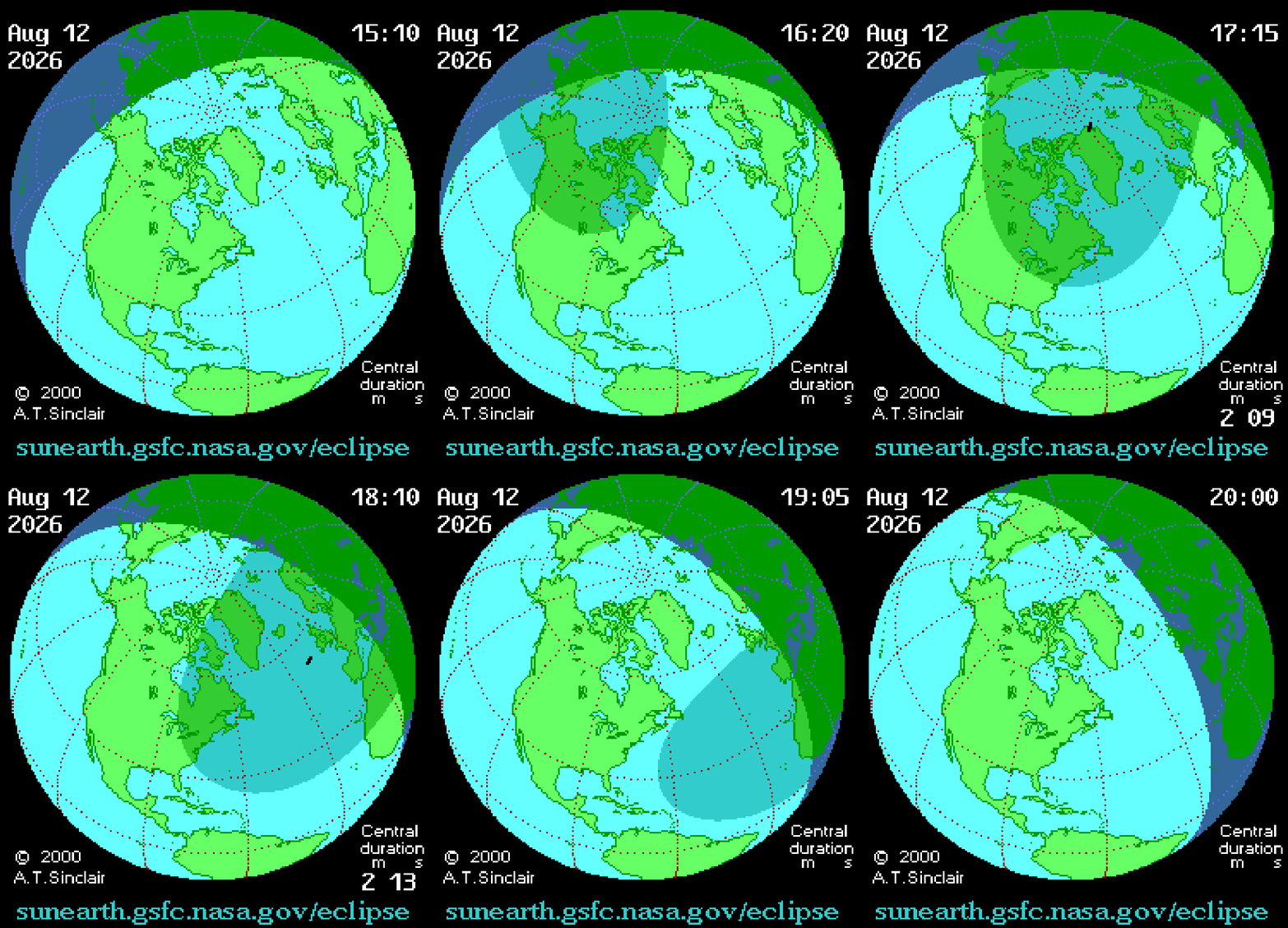
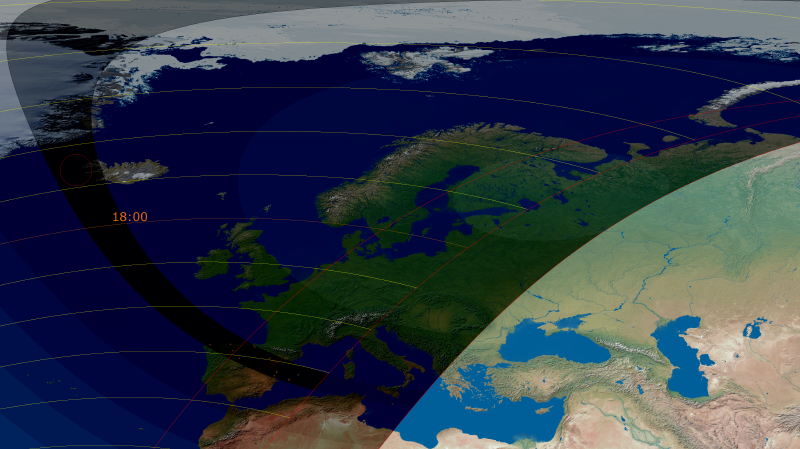
The second reason was geographical. According to the eclipse predictions published by NASA’s eclipse site, the path of totality crossed Arctic regions, Greenland, Iceland, the North Atlantic, Spain and ended over the western Mediterranean. The Iberian Peninsula therefore became one of the main land stages of the event.
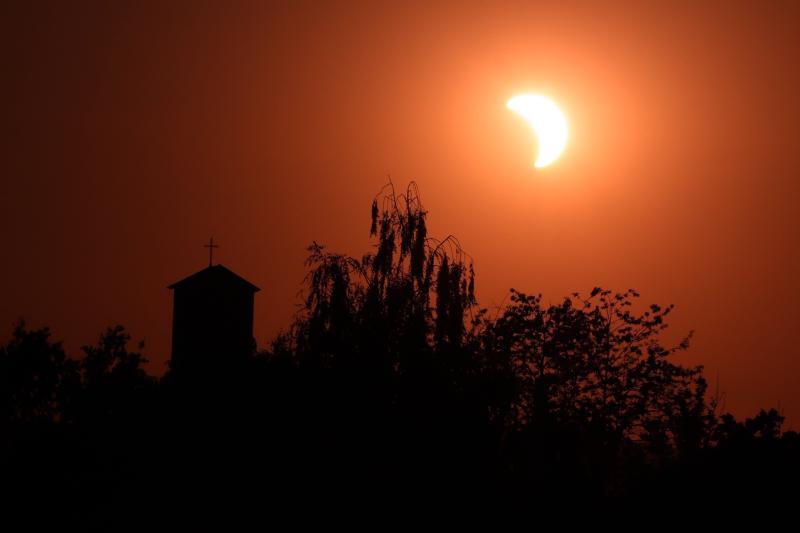
The third reason was timing. Across much of Iberia, the eclipse occurred with the Sun low above the horizon. That geometry brought both difficulties and opportunities. Any western obstacle — mountains, buildings, trees, haze or dust — could compromise the view. At the same time, a total eclipse at sunset creates a very different scene from a midday totality: darkened horizon, grazing light, atmospheric colour and a stronger relationship between sky and landscape.
Finally, it was a major public engagement event. In Portugal, eclipse2026.pt highlighted that the Sun would be obscured by roughly 92% to 100% across mainland Portugal, reinforcing the need for safe observation and preparation.
Portugal during the eclipse #
Across mainland Portugal the eclipse was visible everywhere, but not in the same way. The path of totality touched the far north-east. Elsewhere, the event was partial, although very deep. Many people in Lisbon, Porto, Coimbra, Faro or Évora saw a dramatic eclipse, with a significant drop in brightness, but not the brief night of totality.
That distinction matters. A 95% partial eclipse may sound almost total, but physically it is not the same experience. The solar photosphere is so bright that even a small remaining fraction still illuminates the environment strongly. Temperature may fall, shadows become strange and the light loses its natural quality, but the corona does not appear as it does during totality.
In the northern interior, proximity to the totality path made the experience more dramatic. Areas close to Bragança were much nearer to the complete eclipse. Inside the path itself, the Moon covered the solar disc fully for a short interval, enough to reveal the corona and turn late afternoon into an unusual scene.
Safety was central. Certified eclipse glasses, proper solar filters for telescopes and cameras, and the clear rejection of ordinary sunglasses were repeated messages from scientific organisations and public outreach projects. In such a visible eclipse, public education is as important as astronomical prediction.
Why Bragança was one of the best places in Europe #
Bragança stood out because of a rare combination of geometry, landscape and location. The path of totality crossed the far north-east of Portugal near the Spanish border. Places such as Rio de Onor, the Montesinho Natural Park and nearby border areas were especially well positioned.
The region offered several factors that matter in astronomical observation. First, comparatively low light pollution. During a total solar eclipse, light pollution does not determine whether the Sun is visible, but it affects the perception of the sky, horizon and landscape during totality, especially when the event occurs near sunset.
Second, horizon and landscape. Low totality requires a clear view to the west. Hills, valleys and ridges can block the Sun, but they can also create unique photographic compositions if the observing site is selected in advance. Local preparation — terrain scouting, solar-position simulation, room for last-minute movement and attention to weather — was decisive.
Third, atmosphere. The north-eastern interior can offer transparent late-afternoon skies, although August also brings risks: heat, dust, wildfire smoke and local instability. Observation is never guaranteed by geometry alone. It depends on the real sky on the day.
As for duration, totality in Portugal was short compared with the best central-line locations elsewhere in the path. Still, for anyone inside the shadow, the difference between a few seconds of totality and none at all was absolute. That narrow boundary is what made Rio de Onor and Montesinho so relevant: small movements could determine whether an observer entered or missed the full experience.
Scientific importance #
Total eclipses remain scientifically valuable. The solar corona, normally hidden by the intense brightness of the photosphere, becomes visible during totality. Its structure reveals magnetic-field lines, streamers, plumes and asymmetries that help scientists understand solar activity.
Modern solar physics has satellites, coronagraphs and space observatories, but total eclipses still provide a unique natural condition: the Moon acts as an extremely precise occulting disc. Coordinated ground observations can study the corona in white light, specific spectral lines, polarisation and rapid variations.
The connection with space weather is direct. Solar activity influences the solar wind, energetic particles, geomagnetic storms, communications, satellite navigation, power grids and space operations. NASA, ESA and European institutions track these phenomena through dedicated missions, models and observing campaigns. The 2026 eclipse was another opportunity to connect professional science, observatories, universities and advanced amateur communities.
There is also atmospheric and social science. A rapid drop in solar radiation makes it possible to measure changes in temperature, wind, animal behaviour and public response. The same shadow that fascinates a crowd can provide useful data when planning, instruments and method are present.
Photography #
Photographing an eclipse is a mixture of technique, safety and luck. Before and after totality, any camera pointed at the Sun needs a proper solar filter. This includes telephoto lenses, telescopes, binoculars and tracking systems. The risk is not only to the sensor; it is above all to the eyes of anyone looking through unfiltered optics.
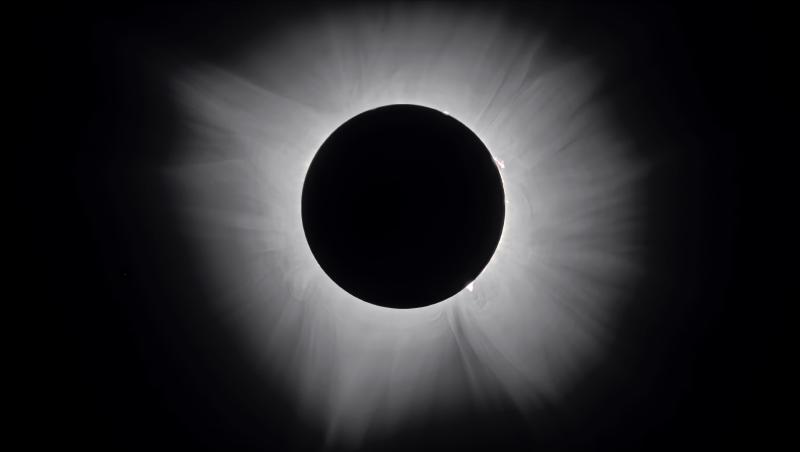
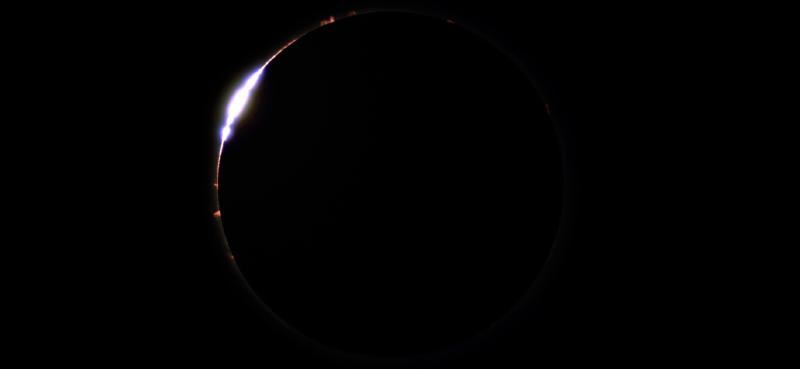
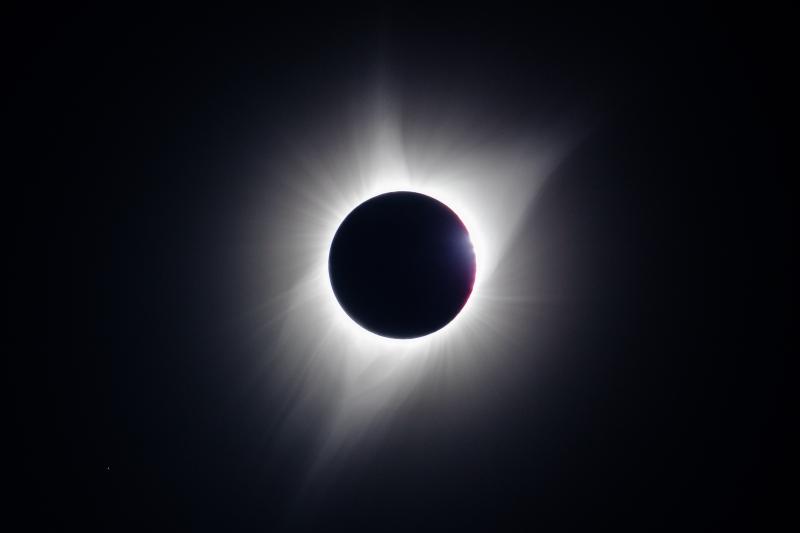
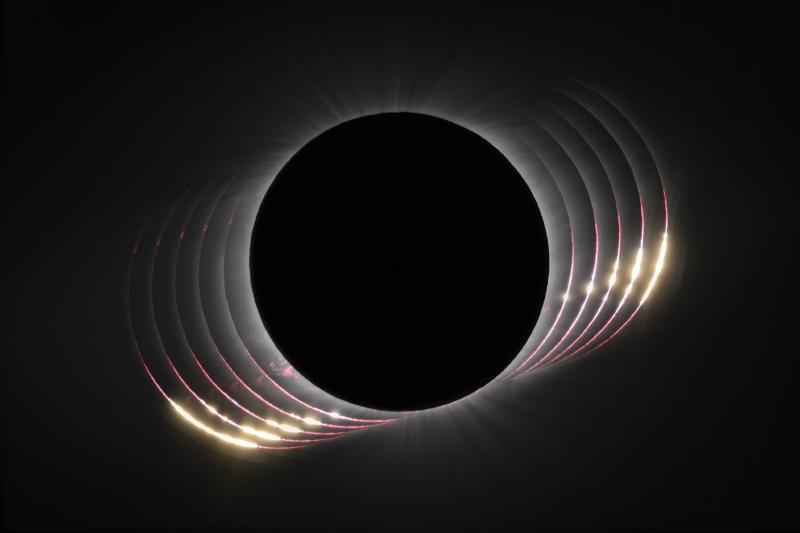
During totality, filters can be removed for a controlled interval. That is when some of the most sought-after moments appear: the diamond ring, when the last point of photosphere shines at the lunar edge; Baily’s beads, caused by valleys and mountains on the Moon’s limb; and the solar corona, delicate and extended, requiring different exposures to reveal inner and outer structure.
In the 2026 eclipse, the additional challenge was the low Sun. The atmosphere increases absorption and turbulence, but it also offers colour and composition. Photographing totality above a horizon, mountain, village or human silhouette became part of the visual story. Recommended equipment ranged from simple setups — certified eclipse glasses and a filtered camera — to advanced systems using telephoto lenses, sturdy tripods, tracking mounts, intervalometers and exposure bracketing.
The best eclipse photograph is not necessarily the most magnified. In a sunset eclipse, the landscape tells part of the story.
Gallery #
The following images were selected only from sources with explicit licensing or public-domain status. Some refer directly to the 2026 eclipse; others illustrate physical phenomena visible during total eclipses.
Interactive map #
To explore the path of totality, the main technical reference remains NASA’s interactive map for the eclipse of 12 August 2026, with local circumstances and central-line information:
Open NASA interactive mapThe map helps place Portugal, the Iberian Peninsula and Bragança within the eclipse geometry. For local planning, it should be combined with topographic maps, weather forecasts and horizon scouting.
Conclusion #
The total solar eclipse of 12 August 2026 reminded us of something simple: science does not live only in laboratories, academic papers or space missions. It also lives when an entire community looks at the same sky with curiosity and care.
Portugal had a special place in that moment. Totality in the far north-east, high visibility across the rest of the mainland and the sunset character of the event turned it into a rare experience. Bragança, Rio de Onor and Montesinho became prominent not by chance, but because the geometry of the Moon’s shadow met a landscape capable of receiving it.
The value of the eclipse did not end when daylight returned. It left images, data, safety lessons, public memories and an opportunity to bring more people closer to astronomy. At a time when technology dominates so many conversations, it is useful to remember that one of the most powerful scientific experiences still requires only three things: sky, method and attention.
What’s next? #
The next major milestone is the total solar eclipse of 2 August 2027, whose path of totality will cross Spain, North Africa and the Middle East. It will be a major event for observers in Europe, Africa and Asia, and deserves its own article because of its duration, geography and accessibility.
Then, on 26 January 2028, an annular eclipse will be visible from Portugal and Spain. In an annular eclipse, the Moon does not completely cover the solar disc; a bright ring remains visible around it. The experience is different from totality, but still astronomically important and requires the same safety precautions throughout the observation.
Future articles on the blog can look at both events in detail: where to observe, how to prepare a trip, which equipment to use and which safety rules should never be forgotten.
Sources #
- NASA Eclipse Web Site — Path of the Total Solar Eclipse of 2026 Aug 12
- NASA Eclipse Web Site — Google Map of the Total Solar Eclipse of 2026 Aug 12
- NASA Eclipse Web Site — Solar Eclipses: 2021–2030
- eclipse2026.pt — public information and safe observation in Portugal
- ESA Multimedia — visual material and scientific context on eclipses and the solar corona
- Wikimedia Commons — Category: Solar eclipse of 2026 August 12